The Most Mass-Produced and Iconic WWII Fighters of Each Major Nation
World War II planes were the evolution of World War I planes; some are fast, some are powerful, some are nimble, from Red Baron to Black Devil, these machines are meant to tear through the skies and destroy as many birds as they can. This is where Aces are made. Today, we're going to list the most iconic planes in World War II, from the Allied to the Axis Powers. We'll be featuring the most produced variants of each iconic type. Let's dive right in!
✈ Germany
|
|
| A Bf-109 G-6/R3 — Long-range reconnaissance fighter variant |
1. Messerschmitt Bf-109 G-6
The 1943 Bf-109 G-6 is a mass-produced masterpiece. Germany wanted a plane that could do it all: dogfighting, interception, and ground attack. The result? 24,000 G-series (Gustav) produced — more than any other Bf-109 variant. The plane featured a 1,475 HP Daimler-Benz DB 605A capable of doing ~640 km/h (398 mph) at ~6,300 m (20,700 ft); ~530 km/h at sea level, and a cruise speed of ~590 km/h (370 mph) at 6,000 m. Armament is upgraded from the previous variant: 2 × 13 mm MG 131 machine guns in the cowling + 1 × 20 mm MG 151/20 cannon firing through the propeller hub. Many carried additional wing-mounted 20 mm cannons, bombs (up to 250–500 kg), and rockets (e.g., WGr. 21). These weapons were capable of ripping bombers, incinerating fighters with ease, and bringing havoc to the ground. The design featured a "Beule" or bumps in the front of the cockpit — this is where the MG 131 machine guns were placed, sacrificing the sleek nose profile. It has a length of 8.95 m (29 ft 4 in); wingspan of 9.925 m (32 ft 7 in); height of 2.6 m (8 ft 6 in) and wing area of 16.05–16.4 m² (172.8–173.3 sq ft). Notable ace: Erich Hartmann scored 352 confirmed kills — the highest of any pilot in history — primarily in the Bf-109.
|
|
| Fw 190 A-8 — strapped with bombs |
2. Focke-Wulf Fw 190 A-8
Nicknamed "Würger" ("Shrike" or "Butcher Bird"), it is another effective multi-role fighter just like its partner — this isn't your light fighter anymore, it packs a lot of punch! It featured a BMW 801D-2 14-cylinder air-cooled radial engine, producing 1,730 hp, but with MW 50 boost, it can reach up to 2,000–2,100 hp! A max speed of ~640–656 km/h (398–408 mph) at ~5,200–6,000 m (17,000–20,000 ft) and a cruise speed of 450–500 km/h. It has an armament of 2 × 13 mm MG 131 in the fuselage + 4 × 20 mm MG 151/20 in the wings — massive firepower ready to rip the B-17s out of the skies. In the R variants like the R2 and R8, featured heavy 30 mm MK 108 cannons on the outer wings and extra add-on armor! This makes the plane heavy, but the most problematic of all is the high-altitude ceiling of 20,000 ft, where some bombers reached 30,000 ft — a weakness fixed in the later D-series "Dora". It has a length of 8.95 m (29 ft 4 in); wingspan of 10.5 m (34 ft 5 in); height of ~3.96 m (13 ft) and wing area of 18.3 m² (197 sq ft). When it debuted over France in 1941, it was so superior to the Spitfire Mk. V that RAF pilots initially thought they were seeing a captured Hurricane.
✈ United States
|
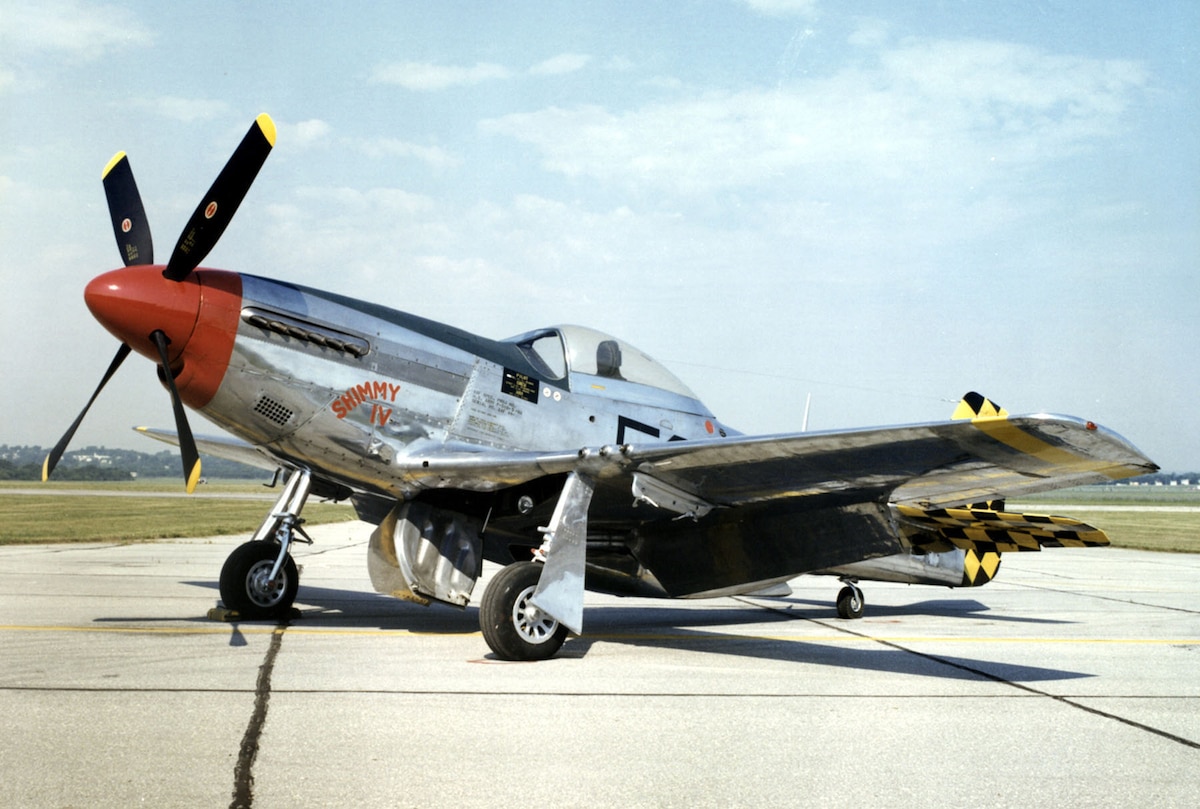
| P-51D Mustang with its iconic bubble canopy |
3. North American P-51D Mustang
One of the most iconic fighters of the war — a result of helping the British since 1940. This freedom fighter featured the Packard V-1650-7 liquid-cooled V-12 engine producing 1,490–1,695 HP, which was a licensed version of the Rolls-Royce Merlin, the same engine found on the Spitfire. It has a maximum speed of ~437–440 mph (703–708 km/h) at ~25,000 ft and a cruise speed of ~362 mph (583 km/h). It is armed with 6 × .50-caliber (12.7 mm) AN/M2 Browning machine guns (3 per wing), with ~1,840 rounds total — deadly without needing cannons. You can strap it with two 250–500 lb bombs, or 6–10 × 5-inch HVAR rockets for ground attacks. This plane excelled in boom-and-zoom tactics thanks to its engine and aerodynamic design. It featured a "jet thrust" effect on its radiator scoop beneath the fuselage — the "Meredith Effect" — where heated air exits through a shaped nozzle, giving a measurable boost in top speed. It has a length of 32 ft 3 in (9.83 m), a wingspan of 37 ft 0 in (11.28 m), and a height of 13 ft 4.5 in (4.08 m). The P-51D's long range — up to 1,650 miles with drop tanks — finally allowed it to escort B-17 and B-24 bombers all the way to Berlin and back, dramatically reducing bomber losses over Germany.
|
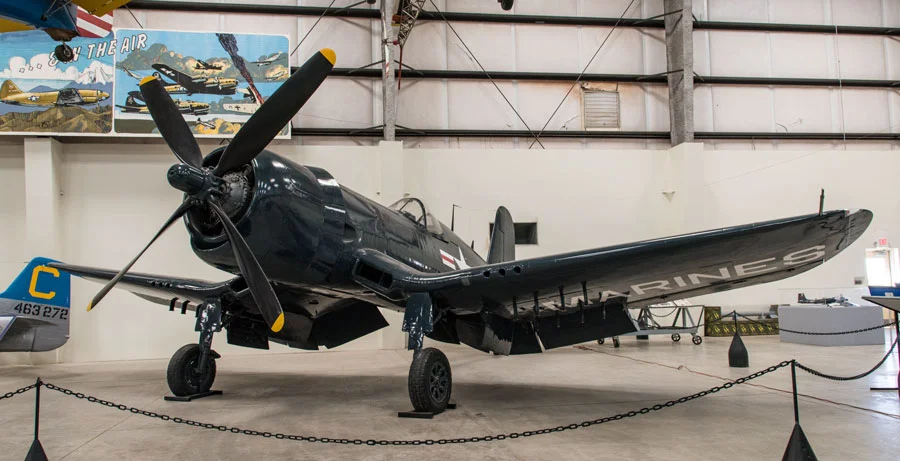
| F4U-4 Corsair with rocket pods |
4. Vought F4U-4 Corsair
Over on the Navy side, we got the F4U-4 Corsair! The F4U-1A is more produced overall, but since it was built outside Vought under license, the F4U-4 is the definitive Vought-built evolution. It has a Pratt & Whitney R-2800-18W or -42W 18-cylinder air-cooled radial engine making 2,100–2,380 hp and up to 2,450 hp with water-alcohol (MW boost) with a max speed of ~446 mph (717 km/h) at ~26,200 ft and a cruise speed of ~215 mph (346 km/h). It has an armament of 6 × .50 caliber (12.7 mm) AN/M2 Browning machine guns (wings) with ~2,400 rounds total — more than the Mustang. It can be strapped with two 1,000 lb bombs — an insane payload for a fighter — or eight 5-inch HVAR rockets. The F4U-4 offered improved speed, climb rate, and high-altitude performance thanks to the two-stage supercharger and four-bladed Hamilton Standard propeller. It retained the Corsair's legendary ruggedness and dive speed while being more versatile as a fighter-bomber. It has a length of 33 ft 8 in (10.26 m); wingspan of 41 ft 0 in (12.50 m); height of 14 ft 9 in (4.50 m), and a wing area of 314 sq ft (29.17 m²). The distinctive inverted gull wing wasn't just for looks — it was an engineering solution to keep the massive propeller from striking the deck on carrier landings.
✈ Japan
|
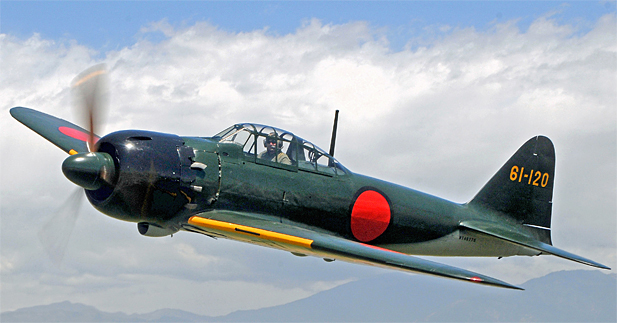
| A6M5 Zero, one of Japan's best fighters |
5. Mitsubishi A6M5 Zero
Make way for the ninja of the skies — the A6M5 Zero is the final major evolution of the legendary A6M Zero that shocked the world at Pearl Harbor, and also one of the most produced variants (with some earmarked for Kamikaze use by 1944–45). This nimble aircraft featured a Nakajima Sakae 21 (NK1F) 14-cylinder air-cooled radial engine making 1,130 hp, with a max speed of ~565 km/h (351 mph) at ~6,000 m (19,685 ft) and a cruise speed of ~330–350 km/h (205–217 mph) — slow by late-war standards but deadly in a turning fight. It has an armament of 2 × 7.7 mm Type 97 machine guns in the cowling (swappable for a 13.2 mm gun in some sub-variants) and 2 × 20 mm Type 99 cannons in the wings. It can carry a pair of 60 kg (132 lb) bombs. The A6M5 was a desperate attempt to keep the Zero competitive against the F6F Hellcat and F4U Corsair — it got improved engine cowling and exhaust stacks for a small speed boost, but the fundamental design was aging fast. It lacks armor and self-sealing fuel tanks by design — the Japanese philosophy was agility over survivability. It has a length of 9.12 m (29 ft 11 in); wingspan of 11.0 m (36 ft 1 in); height of 3.51 m (11 ft 6 in), and wing area of 21.3 m² (229 sq ft).
|
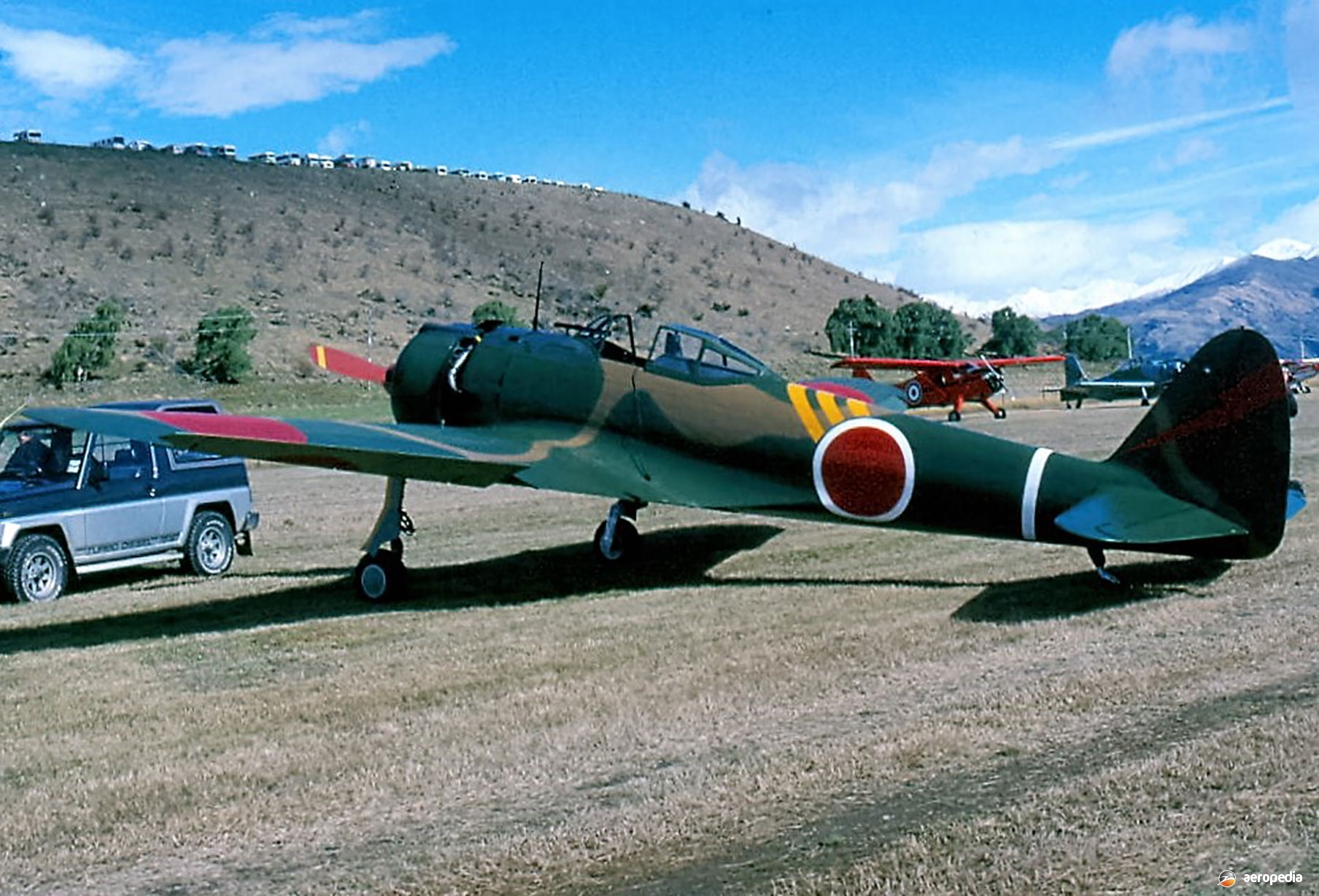
| Ki-43 Hayabusa on the ground |
6. Nakajima Ki-43 Hayabusa
Just like its Navy sibling, the Ki-43 Hayabusa ("Peregrine Falcon") is another lightweight and nimble aircraft, this time for the Imperial Japanese Army Air Force (IJAAF). While the A6M Zero gets all the fame, the Ki-43 was fighting against P-40 Warhawks and Spitfires across Burma, China, and the Pacific during the early stages of the war — largely unrecognized in Western accounts. It featured a Nakajima Ha-115 14-cylinder air-cooled radial engine producing 1,150 hp with a max speed of ~530 km/h (329 mph) and a cruising speed of ~440 km/h — still slow, but built for the turning fight. It has an armament of only 2 × 12.7 mm Ho-103 machine guns, light by late-war standards but enough for early opponents. It can carry up to 2 × 250 kg bombs. Like the Zero, it lacks armor and self-sealing tanks for the sake of agility — and paid the same price when faced with heavier American fighters. Its "butterfly combat flaps" were a unique feature that dramatically tightened its turning radius in a dogfight, making it one of the most maneuverable planes of the war. It has a length of ~8.9 m (29 ft 2 in); wingspan of 10.8 m (35 ft 5 in); height of ~3.3 m (10 ft 10 in), and wing area of ~21.4 m² (230 sq ft).
✈ United Kingdom
|
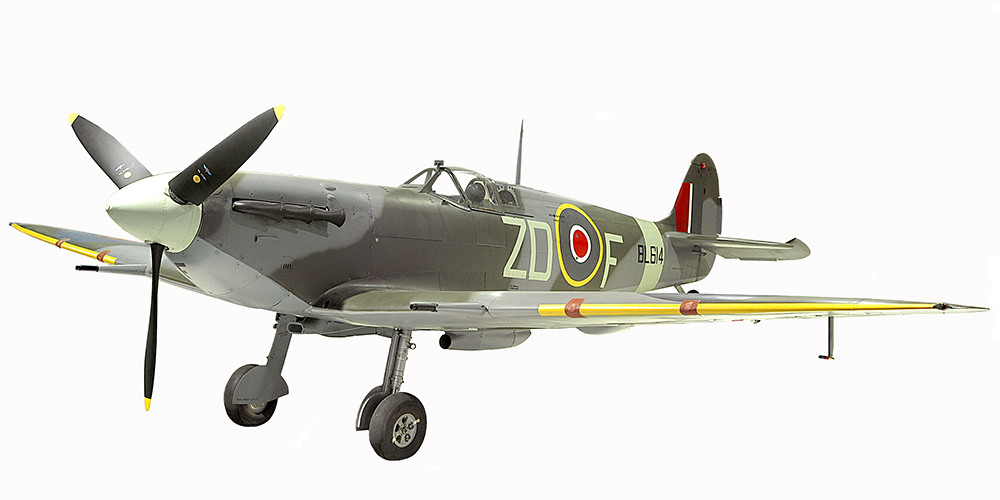
| The Supermarine Spitfire Mk. Vb |
7. Supermarine Spitfire Mk. Vb
The Spitfire Mk. Vb is Britain's answer to overwhelming German air superiority — a quick but effective upgrade over the less competitive Mk. I and Mk. II, featuring a more powerful engine, better climb rate, and improved armament. It featured a Rolls-Royce Merlin 45 12-cylinder liquid-cooled V-12 engine producing 1,440 hp with a max speed of ~603 km/h (375 mph) at ~19,000–20,000 ft and a cruising speed of ~370 km/h (230 mph). It has an armament of 2 × 20 mm Hispano cannons + 4 × .303 in (7.7 mm) Browning machine guns (the Mk. Va uses 8 × 7.7 mm machine guns instead). It can be loaded with a 250 lb or 500 lb bomb under the fuselage. The Spitfire Mk. Vb proved effective against the Bf-109F, however the arrival of the Fw 190 A-series in late 1941 exposed serious weaknesses — the Fw 190 outclimbed, outrolled, and outran the Mk. Vb at low and medium altitude, which pushed Supermarine to accelerate development of the Mk. IX. It has a length of 29 ft 11 in (9.12 m); wingspan of 36 ft 10 in (11.23 m); height of 11 ft 5 in (3.48 m), and wing area of 242 sq ft (22.48 m²).
|
|
| Hawker Hurricane Mk. IIC — four cannons of firepower |
8. Hawker Hurricane Mk. IIC
This Hurricane packs a lot of punch for the skies! Often overshadowed by the Spitfire, the Hurricane actually shot down more enemy aircraft during the Battle of Britain — simply because there were more of them. The Mk. IIC is the most heavily armed variant, proving that some variants could carry up to 12 machine guns in earlier marks. It featured a Rolls-Royce Merlin XX liquid-cooled V-12 engine producing 1,280–1,460 hp (with a two-speed supercharger for better high-altitude performance) with a max speed of ~340–342 mph (547–550 km/h) at ~20,000–22,000 ft and a cruising speed of ~250–280 mph (402–451 km/h). It has an armament of 4 × 20 mm Hispano cannons — enough to obliterate bombers. It can be strapped with up to 1,000 lb (454 kg) of bombs (two 250 lb or 500 lb) and rockets (8 × 60 lb RP-3). The Mk. IIC became a feared ground attack aircraft in the Western Desert and Burma, where its rugged construction and heavy firepower made it ideal for tank-busting. It has a length of 32 ft 3 in (9.84 m); a wingspan of 40 ft 0 in (12.19 m); a height of 13 ft 0 in (3.99 m), and a wing area of 258 sq ft (24.0 m²).
✈ Italy
|
|
| C.202 Folgore — underrated but important aircraft of the Regia Aeronautica |
9. Macchi C.202 Folgore
Italy's best fighter and a critical plane of the Regia Aeronautica — a direct response to the shortcomings of the C.200 Saetta. By borrowing Germany's best engine, Italy produced one of the finest fighters of any Axis power. It featured an Alfa Romeo RA.1000 RC41-I Monsone (licensed Daimler-Benz DB 601) inverted V-12 liquid-cooled engine producing 1,175 hp with a max speed of ~600 km/h (372–373 mph) at ~5,000–6,000 m and a cruising speed of ~500–520 km/h (311–323 mph). It has an armament of 2 × 12.7 mm Breda-SAFAT machine guns in the cowling and 2 × 7.7 mm Breda-SAFAT machine guns in the wings. It can carry up to 2 × 50–160 kg bombs. The C.202 was genuinely competitive against early marks of the Spitfire and P-40 over North Africa — Allied pilots were often surprised by its agility and speed. Its main weakness was armament; the light machine guns struggled against increasingly tough Allied aircraft. It has a length of 8.85 m (29 ft 0 in); wingspan of 10.58 m (34 ft 8 in); height of 3.02 m (9 ft 11 in) and wing area of 16.80 m² (181 sq ft).

|
| RE.2001 Falco II — small but capable |
10. Reggiane RE.2001 Falco II
The most produced plane from Reggiane, built to fly alongside the C.202 Folgore while refining the failed RE.2000. It featured the same Alfa Romeo RA.1000 RC.41-I V-12 liquid-cooled engine making 1,175 hp with a max speed of ~563–600 km/h (350–373 mph) at around 5,000–6,000 m and a cruise speed of ~450–500 km/h (280–311 mph). It has an armament of 2 × 12.7 mm Breda-SAFAT machine guns in the upper cowling and 2 × 7.7 mm Breda-SAFAT machine guns in the wings, plus small bomb capacity. Same firepower as the C.202 Folgore but refined for agility. One notable mission: an RE.2001 attempted to torpedo the British carrier HMS Victorious during the Malta convoy battles in 1942 — a rare case of a fighter being used as a torpedo plane. Like the C.202, it was eventually outclassed by later Allied aircraft. It has a length of 8.36 m (27 ft 5 in); wingspan of 11.00 m (36 ft 1 in); height of 3.15 m (10 ft 4 in) and wing area of 20.4 m² (220 sq ft).
✈ Soviet Union
|
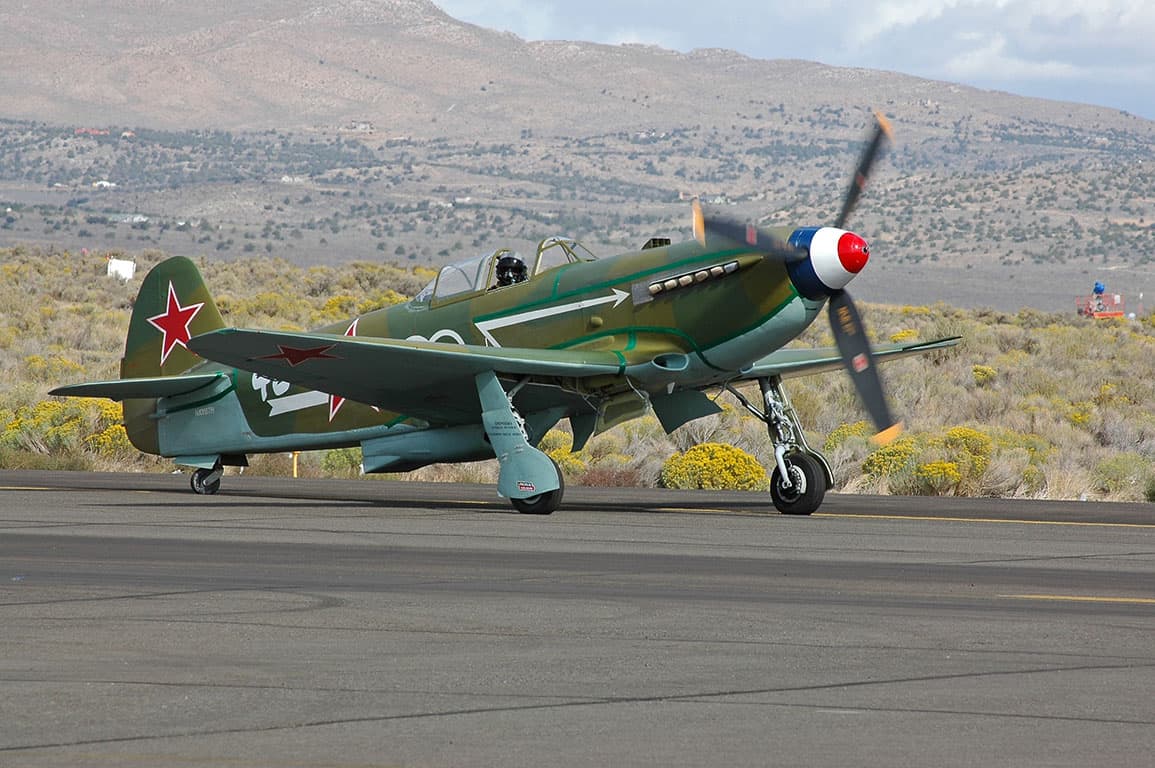
| Yak-9 — one of the most produced Soviet planes of WWII |
11. Yakovlev Yak-9
The Yak-9 is the final evolution of the Yak series and the most produced Soviet fighter of the entire war — over 16,000 built. It featured wooden wings and mixed construction materials that made it fast to mass-produce and accidentally gave it a light, agile airframe. It has the Klimov VK-105PF V-12 liquid-cooled piston engine (~1,260–1,360 hp) with a max speed of ~590–605 km/h (367–377 mph) at ~5,000 m and a cruise speed of ~450–500 km/h (280–311 mph). Armament: 1 × 20 mm ShVAK cannon firing through the propeller hub and 1 × 12.7 mm Berezin UBS heavy machine gun — conservative but reliable. It can be equipped with small bombs or rockets. The Yak-9 came in over 15 sub-variants for different roles — the Yak-9T packed a massive 37 mm cannon for tank-busting, while the Yak-9D had extended range for escort duties. Easy to fly and easy to fix in field conditions, it became the backbone of Soviet air superiority over the Eastern Front from 1943 onward. It has a length of 8.50 m (27 ft 11 in); wingspan of 9.74 m (31 ft 11 in); height of 3.00 m (9 ft 10 in), and wing area of 17.15 m² (184.6 sq ft).

|
| A parked La-5FN |
12. Lavochkin La-5FN
Another Soviet workhorse — born from the failing LaGG-3 when engineers realized that ripping out its inline engine and bolting on a powerful radial transformed a mediocre plane into a serious fighter. It featured a Shvetsov ASh-82FN 14-cylinder air-cooled radial engine with a boosted supercharger producing 1,850 hp — much more powerful than the Yak-9. It has a max speed of 648 km/h (403 mph) at 6,100 m (20,000 ft) and a cruising speed of 480–520 km/h (298–323 mph). It has an armament of 2 × 20 mm ShVAK cannons; it can be strapped with rockets (RS-82) and small bombs (150–200 kg). The La-5FN made its mark at the Battle of Kursk in 1943, where it could finally match the Fw 190 and Bf-109G at low and medium altitude — a pivotal moment for Soviet air power. Ivan Kozhedub, the highest-scoring Allied ace of the entire war with 64 kills, flew the La-5FN and its successor the La-7. It has a length of 8.67 m (28 ft 5 in); wingspan of 9.80 m (32 ft 2 in); height of 2.80 m (9 ft 2 in), and wing area of 17.5 m² (188 sq ft).
Conclusion
Many WWII planes earned their iconic status through engineering, philosophy, and the talents of the people behind the stick or the drawing board. Each plane had its own unique strengths and flaws that pilots had to learn and adapt to — and every complaint and hard lesson fueled engineers to fix whatever got their pilots killed. From the Battle of Britain to Midway to Kursk, these machines fought head-to-head across every theater of the war. In the end, the question was never just which plane was better — it was which side could build more of them, faster, while learning quicker. That's what decided the war in the air.
Thank you so much for reading! I'll see you guys in my next blog.


Comments
Post a Comment